
AI agents in iGaming are software systems that can interpret operational context, choose an appropriate action and use approved tools to complete or coordinate work. For an online casino, that work may include resolving routine support requests, monitoring performance, reviewing quality, preparing payment cases or escalating risk signals.
The important distinction is autonomy within boundaries. An agent does not need unrestricted authority to be useful. The safest model gives it a defined objective, limited access to systems, explicit approval rules and a complete audit trail. High-impact decisions remain with qualified employees.
For COOs, CTOs and operations leaders, the practical question is therefore not whether an agent can imitate a person. It is where controlled agency can reduce queues, improve consistency and help teams respond faster without weakening oversight.
This guide maps seven operational roles for AI agents, the integrations each role may require, the associated risks and the decisions that should remain human-controlled.
What Makes an AI Agent Different From a Chatbot
A chatbot primarily manages a conversation. It receives a message and returns a response, often using scripted flows, retrieval from a knowledge base or a language model. A chatbot may answer a question accurately without taking any action outside the conversation.
An AI agent combines reasoning with controlled action. It can assess a task, retrieve relevant information, select from permitted tools, execute one or more steps, verify the result and escalate when necessary. The interface might still look like a chat window, but the operational capability behind it is different.
| Dimension | Chatbot | AI agent |
|---|---|---|
| Primary purpose | Answer questions or guide a conversation | Complete or coordinate a defined task |
| Context | Usually conversation and knowledge content | Conversation, account context, system state and policies |
| Actions | Often limited to responses and links | May call approved tools or create work in connected systems |
| Workflow | Usually linear or scripted | Can select actions based on conditions |
| Memory | Commonly limited to the session | May retain permitted task state and operational history |
| Escalation | Transfers the conversation | Transfers the case with evidence, context and attempted actions |
| Governance need | Content accuracy and safe responses | Content safety plus access, action, approval and audit controls |
Consider a player asking why a withdrawal is pending. A chatbot might explain general processing stages. An agent could authenticate the request through an approved mechanism, inspect the permitted status fields, identify that a document review is incomplete, explain the next step and create a structured case for the relevant team. It should not independently approve the withdrawal, alter verification results or make an exception to policy unless that specific action has been formally authorized.
Not every automation is an agent. A fixed rule that tags all messages containing a certain phrase is conventional automation. A predictive model that produces a risk score is an analytical component. An agent may use both, but it adds task orchestration: it determines which permitted step should happen next.
This distinction matters because the control model must match the capability. A conversational assistant needs strong content and privacy controls. A system that can read account data, update records or trigger workflows also needs identity management, granular permissions, approval gates, transaction limits, monitoring and rollback procedures.
Seven Operational AI Agent Roles
The strongest initial roles tend to involve frequent, well-defined tasks with observable outcomes. The following use-case matrix provides a portfolio-level view rather than a detailed implementation specification.

| Operational role | Potential value | Typical integrations | Main operational risk | Human approval boundary |
|---|---|---|---|---|
| Customer support | Faster triage and consistent routine resolutions | Help desk, knowledge base, CRM, account-status services | Incorrect guidance or unauthorized account action | Exceptions, complaints and sensitive account changes |
| Analytics | Quicker investigation and recurring operational summaries | Data warehouse, BI tools, event data, catalogues | Misinterpreted data or unsupported conclusions | Material business decisions and metric-definition changes |
| Quality assurance | Broader review coverage and structured defect evidence | Ticketing, test environments, release records, monitoring | False confidence or disruptive automated testing | Release acceptance and production-impacting changes |
| Payment operations | Better case preparation and queue routing | Payment service data, cashier systems, case management | Financial harm, privacy exposure or incorrect disposition | Holds, reversals, approvals and policy exceptions |
| Risk and KYC | Consistent evidence collection and prioritization | Identity verification, risk tools, account data, case systems | Bias, false positives or adverse decisions without context | Verification outcomes, restrictions and suspicious-case decisions |
| Responsible gaming | Faster signal review and escalation support | Player activity data, interaction history, case management | Missed risk or inappropriate intervention | Player-impacting interventions and case closure |
| CRM operations | Better campaign checks, segmentation support and service coordination | CRM, consent records, campaign tools, player data | Unsuitable targeting or consent errors | Eligibility rules, sensitive segments and campaign launch |
Support, analytics, QA and payment operations
1. Customer support
A support agent can classify incoming contacts, retrieve approved information and handle low-risk requests. It may summarize a player’s issue, check non-sensitive status data, suggest a response or perform a pre-authorized action such as opening a ticket with the correct category.
The agent should operate from a governed knowledge source rather than improvising policies. Confidence thresholds are also important: ambiguous bonus terms, formal complaints, account security concerns and vulnerable-player signals should be routed to trained employees.
A useful support outcome is not simply fewer human conversations. Operators should also examine resolution quality, repeat-contact rates, escalation accuracy and whether agents provide employees with complete context. Teams evaluating this role can review the broader model for AI-powered casino customer support.
2. Operational analytics
An analytics agent can translate a business question into a governed query, retrieve approved data and produce a concise explanation. It might monitor recurring indicators, compare current performance with an established baseline or alert an operations manager when a metric moves beyond an agreed threshold.
Its value lies in reducing the time between a question and an initial investigation. However, an agent-generated explanation is not automatically a causal conclusion. Data quality, metric definitions, attribution and statistical uncertainty still matter.
Access should reflect the user’s role. The agent should expose the query or calculation behind its answer, identify missing data and distinguish observation from interpretation. Significant commercial or operational decisions should be reviewed by the accountable owner. See AI casino analytics for the solution context around governed analytical assistance.
3. Quality assurance
A QA agent can review requirements, generate bounded test scenarios, compare expected and observed behavior, group similar defects and prepare evidence for engineers or release managers. It can also help identify recurring patterns across support cases and incident reports.
This role is particularly suitable for repetitive checking, but it should not become the sole release gate. An agent can miss unusual dependencies, misunderstand business intent or report a technically correct result that creates a poor player experience.
Human QA and product owners should retain responsibility for risk-based test coverage, release acceptance and decisions affecting live services. Any agent allowed to interact with a test environment should have clear limits; production access requires a much higher level of control.
4. Payment operations
A payment-operations agent can assemble case information, identify missing fields, classify common failure reasons and route a case to the appropriate queue. It may also draft a player-facing status explanation using approved language.
The principal benefit is better case preparation. Employees spend less time collecting fragmented information and more time assessing the cases that require judgment. The agent’s output should show which systems were checked, what evidence was found and why a particular route was proposed.
Financial actions require strict boundaries. Approving or rejecting a transaction, releasing a hold, reversing a payment or overriding a limit can create direct harm. These decisions should remain subject to defined authorization, segregation of duties and applicable operator policies.
Risk/KYC, responsible gaming and CRM operations
5. Risk and KYC
A risk or know-your-customer agent can collect evidence from approved sources, check whether required information is present, summarize inconsistencies and prioritize cases for review. It can make a complex case easier for an analyst to understand without making the final determination.
The danger is treating an automated score or summary as a complete decision. Identity, fraud and financial-crime cases often contain ambiguous evidence. Data may be stale, incomplete or associated with the wrong person. Models can also produce uneven results across different populations or document types.
The agent should therefore cite the evidence supporting each recommendation and make uncertainty visible. Human specialists should control verification outcomes, account restrictions, enhanced review and any reporting or escalation required under the operator’s policies and jurisdictional obligations.
6. Responsible gaming operations
A responsible gaming agent can help teams review behavioral signals, interaction history and existing case notes. It may prioritize cases, prepare a timeline and alert an authorized employee when predefined conditions are met.
Speed and consistency are valuable, but this is a high-stakes context. A language model should not independently diagnose a player, infer sensitive conditions without a valid basis or decide that no further action is needed. It should also avoid persuasive messaging that conflicts with the operator’s responsible-gaming controls.
Human reviewers should determine interventions, assess contextual information and decide when a case can be closed. The design should favor conservative escalation when evidence is incomplete, with clear monitoring for missed signals and excessive false positives.
7. CRM operations
A CRM agent can prepare segments, check campaign inputs, summarize recent player interactions and coordinate service messages across approved channels. It may identify duplicate communications, flag missing consent data or propose the next operational task.
Its role should be constrained by eligibility, consent, suppression and responsible-gaming rules. An agent should not optimize solely for response or revenue while ignoring player status and communication restrictions.
Campaign owners remain accountable for targeting logic, content approval and launch. Sensitive segments, reactivation activity and any treatment based on inferred behavior deserve additional review. The agent should record the data, policy and rule version used for every recommendation.
What Should Stay Human-Controlled
Human control should be based on impact, not on whether the agent appears confident. A fluent explanation can still be wrong, incomplete or based on outdated information.
Casino operators should retain meaningful human authority over:
- account suspension, closure or reinstatement;
- KYC and enhanced-review outcomes;
- payment approvals, rejections, reversals and exceptions;
- responsible-gaming interventions and case closure;
- formal complaints and regulatory communications;
- changes to player balances, limits or material entitlements;
- campaign approval for sensitive or restricted groups;
- production releases and high-impact configuration changes;
- policy interpretation where rules are ambiguous;
- access-right changes and emergency overrides.
“Human in the loop” must be more than a button at the end of an automated process. The reviewer needs enough time, evidence and authority to challenge the recommendation. The interface should show source data, actions already taken, confidence or uncertainty, and the applicable policy.
Different control patterns can coexist. Low-risk actions may be automated and reviewed through sampling. Medium-risk actions may require approval before execution. High-risk decisions should remain human-led, with the agent limited to evidence gathering and administrative support.
AI Agent Architecture for Casino Operators
A practical architecture separates decision logic from permissions and system access. This prevents a language model—or any single component—from becoming an unrestricted control layer.
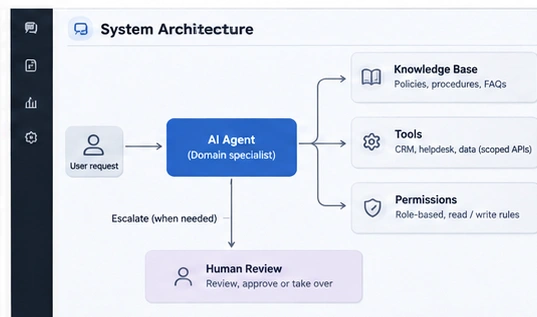
A high-level architecture usually contains six elements:
- Interaction and event layer: Receives employee requests, player contacts or system events. It identifies the task and carries authenticated context forward.
- Orchestration layer: Breaks the task into permitted steps, selects appropriate tools and applies workflow rules. It should stop when a required condition is not met.
- Knowledge and data layer: Provides approved policies, product information, account context and analytical data. Retrieval should respect jurisdiction, brand, role and data classification.
- Tool and integration layer: Connects the agent to help desks, CRM platforms, analytics systems, payment case tools and other services through constrained interfaces.
- Policy and approval layer: Enforces permissions, transaction limits, confidence thresholds, escalation rules and human approval requirements independently of the model’s response.
- Observability and audit layer: Records inputs, retrieved evidence, tool calls, approvals, outputs and errors. Monitoring should support investigation without exposing data more broadly than necessary.
Security applies across every layer. Operators need service identities, least-privilege access, secret management, data minimization and controls against malicious or misleading instructions in user-supplied content. Logs should be useful for oversight while following applicable retention and access policies.
Models and external services can change over time, so evaluations should be repeatable. Version records, test sets and staged releases help teams determine whether a change has improved one metric while degrading another. This architecture is a governance framework, not a substitute for a detailed integration and security design.
How to Choose the First Use Case
The best first use case is usually bounded, measurable and reversible. It does not have to be the task with the greatest theoretical return.
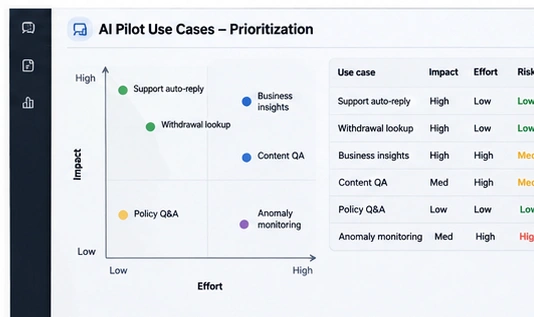
Use this selection process:
- Build a task inventory. List frequent operational tasks, their owners, current volumes, handoffs and common failure points.
- Separate assistance from authority. Identify whether the agent would summarize, recommend, prepare or execute. Favor assistance before autonomous execution.
- Assess data readiness. Confirm that the required information is accessible, current, well-defined and legally appropriate for the intended purpose.
- Rate operational risk. Consider financial impact, player harm, regulatory sensitivity, privacy exposure and the difficulty of reversing an action.
- Define a narrow boundary. Specify which cases are eligible, which tools can be used and which conditions force an escalation.
- Choose measurable outcomes. Establish baseline measures before the pilot so that speed does not become the only definition of success.
- Run in observation mode first. Compare recommendations with real employee decisions without allowing the agent to act.
- Expand only after review. Grant limited action rights when evidence shows acceptable quality, reliable escalation and effective oversight.
A useful shortlist scores candidates against consistent criteria:
- high task frequency;
- clear inputs and outputs;
- reliable source data;
- low or reversible impact;
- objective quality checks;
- manageable integration needs;
- a clear operational owner;
- sufficient human review capacity.
Routine support classification or analytics summarization may satisfy these conditions more readily than payment disposition or responsible-gaming decisions. The answer depends on each operator’s systems, policies and control maturity.
KPIs, Pitfalls and Next Steps
AI agent performance should be evaluated as an operational system, not only as a model. A faster process is not better if it creates more repeat contacts, poor escalations or hidden risk.
Use a balanced KPI set:
| KPI category | Measures to consider | Question answered |
|---|---|---|
| Efficiency | Handling time, queue age, time to resolution, employee time saved | Is work moving faster? |
| Quality | Resolution accuracy, defect detection, rework, repeat contact | Is the result correct and durable? |
| Escalation | Escalation precision, missed escalations, context completeness | Does the agent recognize its limits? |
| Risk and control | Unauthorized actions, policy breaches, approval overrides, audit completeness | Are boundaries working? |
| Experience | Player satisfaction, employee acceptance, complaint rate | Is the workflow useful to people? |
| Reliability | Tool failures, latency, incomplete tasks, recovery success | Does the service operate consistently? |
Common pitfalls include:
- automating an unclear or broken process;
- giving the agent more access than the task requires;
- relying on model confidence without independent rules;
- using ungoverned knowledge or inconsistent metric definitions;
- measuring containment while ignoring resolution quality;
- designing escalation as an afterthought;
- allowing employees to approve recommendations without seeing evidence;
- expanding scope before the pilot has covered edge cases;
- failing to monitor changes in data, policies, tools or model behavior;
- treating responsible gaming, KYC or payments like ordinary back-office tasks.
The next step is to select one bounded workflow and document four things: expected value, required integrations, operational risks and human approval points. That simple matrix creates a shared basis for operations, technology, compliance and service owners to decide whether an agent is appropriate.
Operators exploring the broader platform approach can explore AI agents for online casinos. The goal is not maximum autonomy. It is dependable operational support that acts only within explicit permissions, produces evidence for its decisions and hands control to people whenever judgment carries material consequences.